

 t. George is the protector of women and a model of chivalry.
His existence, however, is disputed. One tradition preserved in
the Golden Legend says that he was a late 3rd-century
Roman centurion of Cappadocia, Asia Minor, a Christian in the
service of a pagan emperor. Travelling through Libya he found
the inhabitants of the city of Silene (in other versions, Beirut
of the Levant) living in the terror of a dragon which had eaten
their sheep and could only be appeased by the daily sacrifice
of a maiden.
t. George is the protector of women and a model of chivalry.
His existence, however, is disputed. One tradition preserved in
the Golden Legend says that he was a late 3rd-century
Roman centurion of Cappadocia, Asia Minor, a Christian in the
service of a pagan emperor. Travelling through Libya he found
the inhabitants of the city of Silene (in other versions, Beirut
of the Levant) living in the terror of a dragon which had eaten
their sheep and could only be appeased by the daily sacrifice
of a maiden.
 he king's beautiful daughter,
Cleodolinda was waiting her turn to be the dragon's next victim. She was dressed as a bride and
was standing at the mouth of the dragon's cave by the sea. George
rode up on his white charger, overcame the dragon, bound it
with the princess's girdle, and told her to lead it back to
the city. Her father and 15,000 of his people were astounded
by their miraculous deliverance and agreed to become Christians.
George then killed the dragon. He then went on to Palestine
where he refused to recognize the divinity of Emperor Diocletian.
He was dragged along the highway by wild horses, then roasted
and finally beheaded.
he king's beautiful daughter,
Cleodolinda was waiting her turn to be the dragon's next victim. She was dressed as a bride and
was standing at the mouth of the dragon's cave by the sea. George
rode up on his white charger, overcame the dragon, bound it
with the princess's girdle, and told her to lead it back to
the city. Her father and 15,000 of his people were astounded
by their miraculous deliverance and agreed to become Christians.
George then killed the dragon. He then went on to Palestine
where he refused to recognize the divinity of Emperor Diocletian.
He was dragged along the highway by wild horses, then roasted
and finally beheaded.
t. George is the patron of
Venice, Genoa, Portugal, Catalonia and Greece. He replaced St. Edward the Confessor as patron saint
of England in 1222 after the Crusades, when he appeared to Richard
LionHeart before the siege of Antioch and promised him victory.
The cry, "St. George for England", also proved effective
in enabling Edward III (1327-1377) to beat the French. His red
cross represents England on the Union Jack, and his feast day,
April 23, is the English National Day. The St. George's Channel
(or Irish Sea) is so named because he is said to have visited
England by that route. As patron of the Order of the Garter,
he is sometimes shown in the robes of that Order. The church
where the members' banners are placed, St. George's Chapel,
Windsor, is dedicated to him. He is one of the Fourteen Holy
Helpers, a group of saints who were especially responsive to
prayers for help in recovery from illness and for those who
prayed for an easy death.
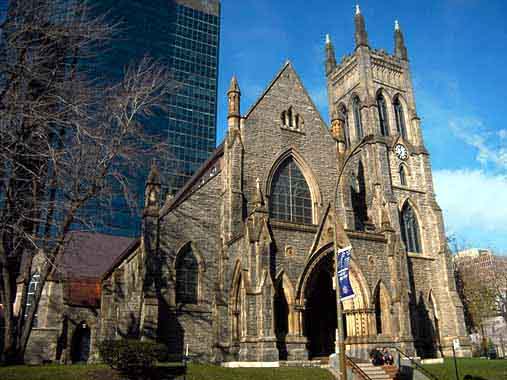
Photo: D. Stiebeling
t.
George’s opened in 1843 to accommodate the overflow ("chapel
of ease") from Christ Church Cathedral and was first located
on what is now Notre Dame Street, just outside the city walls.
The present building was opened for worship on October 9, 1870.
Its main features include the magnificent double hammer-beam
roof (one of the largest of its type in the world) the unique
column-free interior which combines elements of both English
and French Gothic plans, and the superb English wood-carving
in the chancel.
The congregation has, and continues to have, a profound impact
not only on the religious and social life of Montreal but also
on the expansion of Christian work throughout Canada.
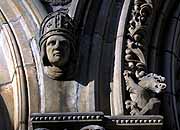
Photo: D. Stiebeling
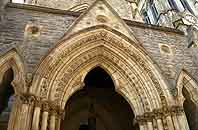
Photo: C. Turmel
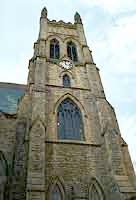
Photo: C. Turmel
 n 1893,
Mr A.F. Gault contributed generously to the cost of
building the church tower. He was a prominent Montreal business
man and a great public benefactor. Mr Gault gave the bells,
clock and chimes to St. George's as a gift. The set of bells
was ordered from England, thirteen tubular bells which were
a number five in size, the largest in "C". The order
was received in England in 1899. These bells arrived in December
of that year, a series of suspensed metal tubes, from 5 to 10
feet in length, and weighing from 30 to 200 pounds.
n 1893,
Mr A.F. Gault contributed generously to the cost of
building the church tower. He was a prominent Montreal business
man and a great public benefactor. Mr Gault gave the bells,
clock and chimes to St. George's as a gift. The set of bells
was ordered from England, thirteen tubular bells which were
a number five in size, the largest in "C". The order
was received in England in 1899. These bells arrived in December
of that year, a series of suspensed metal tubes, from 5 to 10
feet in length, and weighing from 30 to 200 pounds.
he
bells turned out to be a complete failure at St. George's because
they were too loud to be rung in a city center. They were meant
to ring out over a large open expanse of land. After much criticism,
the bells did in fact, end up in the tower of a country church
where they rang out, in a tower on a hilltop with higher elevation
than St. George's. Subsequently, a new set of ten bells of a
lower tone was sent to St. George's. These ten were first rung
in 1901. Everyone was very satisfied and found the sound "beautiful".
he
carillon was set up to play automatically or by hand every
three hours. There were four barrels, each containing 7 religious
and secular tunes. The carillon ceased to play many years ago,
since people complained that the sound disturbed them.
When the tower was built, the architect considered putting a clock in it. However, he was concerned that a clock might spoil its appearance. In addition, because the clock would be facing Windsor Station, the architect was afraid that, should the clock be inaccurate, he would have to face the wrath of the travelers who might miss their train.
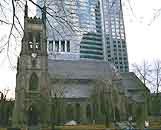
Photo: C. Turmel
 owever,
the clock was installed and was faithfully on time,
losing exactly 6 seconds per year. In an era when the wrist
watch had not been invented, and pocket watches more inaccessible
under winter apparel, the public clock was of great service
to people. The clock was, at that time, illuminated with a 32
to 50 watt candle lamp on each dial. The dials were five feet
in diameter and of the best opal glass. It was ordered in 1899
at a cost of 255 pounds sterling. It arrived a year later. It
chimed the quarter hours and never less than twice, sometimes
more, during sermons! Today, the chimes do not ring, nor does
the carillon, but the clock still tells time and the bells are
played prior to services on a small keyboard situated in the
church proper.
owever,
the clock was installed and was faithfully on time,
losing exactly 6 seconds per year. In an era when the wrist
watch had not been invented, and pocket watches more inaccessible
under winter apparel, the public clock was of great service
to people. The clock was, at that time, illuminated with a 32
to 50 watt candle lamp on each dial. The dials were five feet
in diameter and of the best opal glass. It was ordered in 1899
at a cost of 255 pounds sterling. It arrived a year later. It
chimed the quarter hours and never less than twice, sometimes
more, during sermons! Today, the chimes do not ring, nor does
the carillon, but the clock still tells time and the bells are
played prior to services on a small keyboard situated in the
church proper.
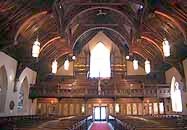
Photo: D. Stiebeling
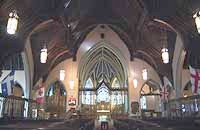
Photo: D. Stiebeling
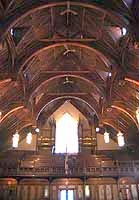
Photo: D. Stiebeling
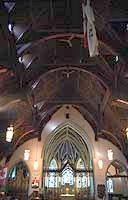
Photo: D. Stiebeling
he
floor plan of St. George's Church forms the shape of a cross
consisting of the chancel, the body of the cross being the nave
and the arms being the transepts. The nave is derived from the
Latin "navis" or "a ship" because the Church
is compared to a ship in which the faithful would be saved.
East (the Orient) is the point of the compass where the sun
(Christ) appears, hence the source of light and truth.
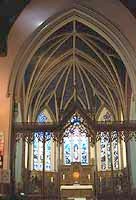
The Sanctuary
Photo: D. Stiebeling
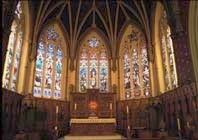
The Lancet Windows.
Photo: D. Stiebeling
t. George's Church is blessed with a wealth of beautiful stained glass windows.
In the sanctuary are five large lancet windows, from left to right:
1. The presentation of our Lord in the temple, The Good Samaritan, The Journey to Emmaus, in memory of the Hon. John Elliot
2. The Ascension, in memory of the Hon. George Moffat
3. The Good Shepherd, in memory of Mrs. Fulford, wife of the first Bishop of Montreal
4. The Raising of Jairus' Daughter, Teach us to pray, The Call to Samuel, in memory of Edith Molson
5. The parable of the Labourers in the vineyard, in memory of William Molson
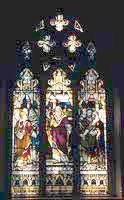
Photo: D. Stiebeling
he
window representing "Samuel and People's Request for a
King" was erected to the memory of the Hon. Thomas White,
M.P. Minister of the Interior and Superintendent General of
Indian Affairs in Canada.
"And Samuel heard all the words of the people and rehearsed
them in the ears of the Lord" (1 Samuel 8:21).
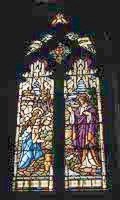
Photo: D. Stiebeling
n
memory of Miles Williams, Christ and the Woman at the well
"God is a spirit and they that worship Him must worship
Him in spirit and in truth" (John 4:24).
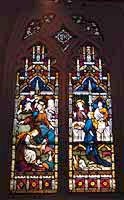
Photo: D. Stiebeling
his
window represents Woman Washing the feet of our Lord,
in memory of Jessie Dunlop, the wife of the Rev. John Empson,
M.A.
"He said unto her, "Thy sins are forgiven" (Luke
7:48)
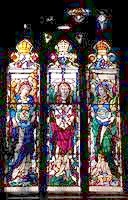
Photo: D. Stiebeling
he
stained glass commemorates the men and women who fought in World
War II. Each panel represents a branch of the Armed Forces:
Left panel: the Navy "They that go down to the sea in ships,
these see the works of the Lord and his wonders of the deep"
(Psalms 107:23).
Centre panel: the Army "He will swallow up death in victory
and the Lord God will wipe away all tears from all faces"
(Isaiah 25:8).
Right panel: the Air Force "Out of weakness made strong,
waxed valiant in fight, turned to flight the armies of the aliens"
(Hebrews 11:34).
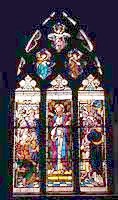
Photo: D. Stiebeling
 iven
to honour the 50 years in the Priesthood of Archdeacon A.P.
Gower-Rees, the window depicts Jesus in the Synagogue
at Nazareth:
iven
to honour the 50 years in the Priesthood of Archdeacon A.P.
Gower-Rees, the window depicts Jesus in the Synagogue
at Nazareth:
"The spirit of the Lord is upon me because he hath appointed
me to preach the gospel to the poor, he hath sent me to heal
the broken hearted, to preach deliverance to the captives and
recovery the sight to the blind, to set at liberty them that
are bruised, to preach the acceptable year of the Lord "-
and he closed the book. (St. Luke 4:18, 19).
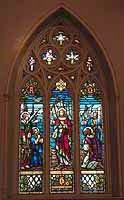
Photo: D. Stiebeling
his
windows depicts Jesus calling to his disciples to be fishers
of men. It was given in memory of Guy de Lancey Robinson and
his wife Constance Gordon Smith.
"He aid unto them, "follow me and I will make you
fishers of men" (Matthew 4:19).
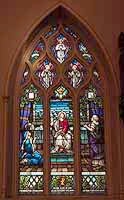
Photo: D. Stiebeling
n
memory of Lansing Lewis, his wife Katherine Bate and Helen McKim
Lewis, this biblical scene shows Jesus at the home of Mary and
Martha. Jesus reminds Martha that Mary's spirituality is as
important to her as Martha's practicability is to her.
"Mary hath chosen that good part which shall not be taken
away" (Luke 10:42).
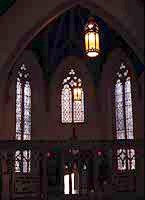
Photo: D. Stiebeling
tained glass, south transept
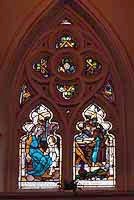
Photo: D. Stiebeling
 hrist
in the house of His Parents
hrist
in the house of His Parents

Credits for the information on this page are given to the Religious Heritage Foundation.
TO KNOW CHRIST AND MAKE HIM KNOWN! CONNAÎTRE LE CHRIST ET LE FAIRE CONNAÎTRE !
St. George’s Anglican Church
1101 Stanley Street
Montréal (Québec) H3B 2S6
Canada
Telephone: 514 866-7113
Fax: 514 866-6096
Église anglicane Saint-Georges
1101, rue Stanley
Montréal (Québec) H3B 2S6
Canada
Téléphone : 514 866-7113
Télécopieur : 514 866-6096
E-mail:
Courriel :
Website: Site internet :
© 1998 – Updated onMise à jour le 2005-08-09
